As next-generation AI chips approach launch, competition among memory giants is intensifying. Samsung is reportedly set to ship HBM4 first, but supply shares tell a more complex story involving SK hynix and Micron.
The race toward the HBM4 era
With new AI accelerators on the horizon, demand for high-bandwidth memory is entering another explosive growth phase. Industry sources indicate that the upcoming wave of AI hardware will rely heavily on HBM4, the next evolution of stacked DRAM designed to feed data-hungry processors at extreme speeds. Against this backdrop, Samsung, SK hynix, and Micron are locked in a high-stakes contest to secure supply positions.
Reports from Korean media suggest Samsung may become the first company to begin mass shipments of HBM4 shortly after the Lunar New Year. However, being first to ship does not automatically translate into market dominance. Initial supply allocations are expected to be split, with Samsung holding roughly a quarter of early volume.
How supply is being divided?
Industry insiders say major AI chip customers tentatively mapped out HBM4 sourcing plans in late 2025. SK hynix is believed to have secured the largest portion, estimated at over half of early supply. Samsung’s allocation is reportedly in the mid-20 percent range, while Micron is expected to take a smaller but still meaningful share.
These early splits reflect more than just technology leadership. Long production cycles, capacity planning, and prior performance with earlier HBM generations all influence how customers distribute orders. Since HBM manufacturing can take more than six months from wafer start to finished stacks, suppliers must lock in capacity well ahead of actual product launches.
Samsung’s technology push with HBM4
Even with a smaller initial slice, Samsung appears determined to make a strong technical statement. Reports indicate the company cleared key customer qualification tests ahead of schedule, enabling it to move into mass production sooner than many expected.
A major factor behind Samsung’s performance claims is its process combination. The company is said to pair its latest 10nm-class sixth-generation DRAM with an advanced 4nm logic process for the HBM4 base die. This approach is designed to maximize both speed and efficiency inside each memory stack.
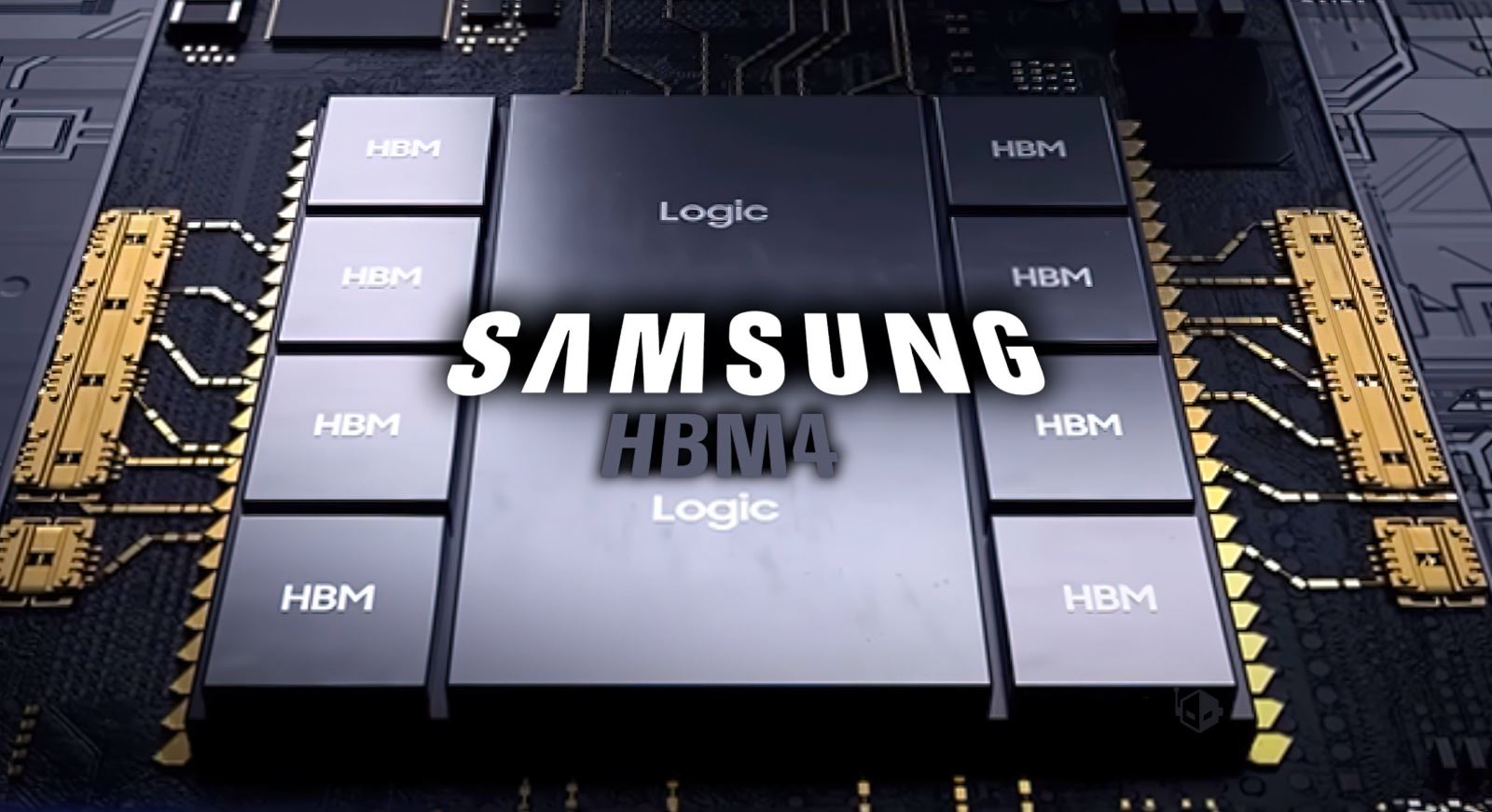
Performance figures circulating in the industry suggest Samsung’s HBM4 can reach data rates of up to 11.7Gbps. That is significantly above the official baseline defined by standards bodies and noticeably faster than previous HBM3E generations. In bandwidth terms, a single stack is reported to deliver up to around 3TB per second, a dramatic jump over earlier designs.
Capacity is also scaling. Using 12-layer stacking, a single HBM4 stack can reportedly reach 36GB. With more aggressive 16-layer stacking, capacity could climb to 48GB per stack. For AI accelerators that integrate multiple HBM stacks around a single processor, this opens the door to enormous on-package memory pools.
A dual-track business strategy
Despite the spotlight on HBM4, Samsung’s broader memory strategy appears carefully balanced. HBM products involve advanced packaging, complex stacking, and tighter yields, all of which raise production costs. By contrast, mainstream DRAM products are simpler to manufacture at scale and often deliver higher margins.
Industry analysis suggests Samsung is using HBM4 partly as a technology showcase while continuing to rely heavily on conventional DRAM for profitability. The company’s overall DRAM capacity is reportedly larger than many competitors, giving it flexibility to shift output depending on market conditions and pricing trends.
The advanced process choices behind Samsung’s HBM4 may also carry risks. Using a cutting-edge foundry node for the base die and its most advanced DRAM generation could mean higher manufacturing costs and more yield uncertainty compared with rivals using slightly more mature processes. This makes careful capacity allocation even more critical.
Capacity constraints in the AI era
Like other memory manufacturers, Samsung is not immune to capacity bottlenecks driven by the AI boom. Output of its latest-generation DRAM is still a fraction of total DRAM production, and expanding advanced-node capacity takes time and heavy capital investment.
New production lines are being ramped, but it may take a year or more before monthly wafer output for the newest DRAM nodes reaches targeted levels. Until then, Samsung must juggle demand across HBM, server DRAM, and other high-growth segments, all while memory prices remain elevated.
Why SK hynix holds the largest share?
If Samsung is first to ship and touts leading performance, why does SK hynix appear to control the biggest share of early HBM4 supply? The answer likely lies in track record and scale.
Customers placing large AI memory orders tend to favor suppliers with proven experience delivering previous HBM generations at high volume. SK hynix has been a dominant player in HBM3 and HBM3E, and that history may have reinforced confidence in its ability to execute on HBM4 at scale.
In addition, the supplier with the largest dedicated HBM production capacity is often best positioned to support massive ramp-ups tied to new AI chip launches. For customers planning aggressive deployments, guaranteed volume can outweigh marginal performance differences.
Micron’s position in the mix
Micron, the third major memory player in this space, appears to face a more uncertain start in HBM4. Market chatter suggests it may be encountering challenges in early supply or qualification, potentially limiting its initial allocation.
However, Micron is not out of the AI memory race. It is expected to provide other types of high-performance memory, such as LPDDR5X, for certain AI-related processors. These products can still represent significant volume and revenue, helping offset a smaller role in early HBM4 shipments.
An evolving competitive landscape
The HBM4 cycle is still in its early stages, and supply shares are not set in stone. As yields improve, new capacity comes online, and additional qualifications are completed, the balance among Samsung, SK hynix, and Micron could shift.
What is clear is that HBM has become one of the most strategic battlegrounds in the semiconductor industry. Performance leadership, manufacturing scale, and the ability to execute reliably under intense demand will all shape how the next phase of AI infrastructure is built. In this environment, even a mid-20 percent share of HBM4 can translate into a major foothold in one of the fastest-growing segments of the memory market.
